Scarlet Kimono
The Scarlet Kimono is a garment that becomes a central, deliberately planted piece of evidence in the murder of Samuel Edward Ratchett on the Orient Express. Its appearance on the night of the crime, its description by multiple witnesses, and its final, theatrical discovery in Hercule Poirot's own suitcase are all part of an elaborate scheme designed by the twelve conspirators to mislead the investigation and create a false trail. The kimono serves as a classic red herring, a manufactured clue that points toward a phantom suspect, and its journey through the narrative reveals the meticulous planning and theatrical flair of the self-appointed jury of the Armstrong family's avengers.
Appearance and Witness Accounts
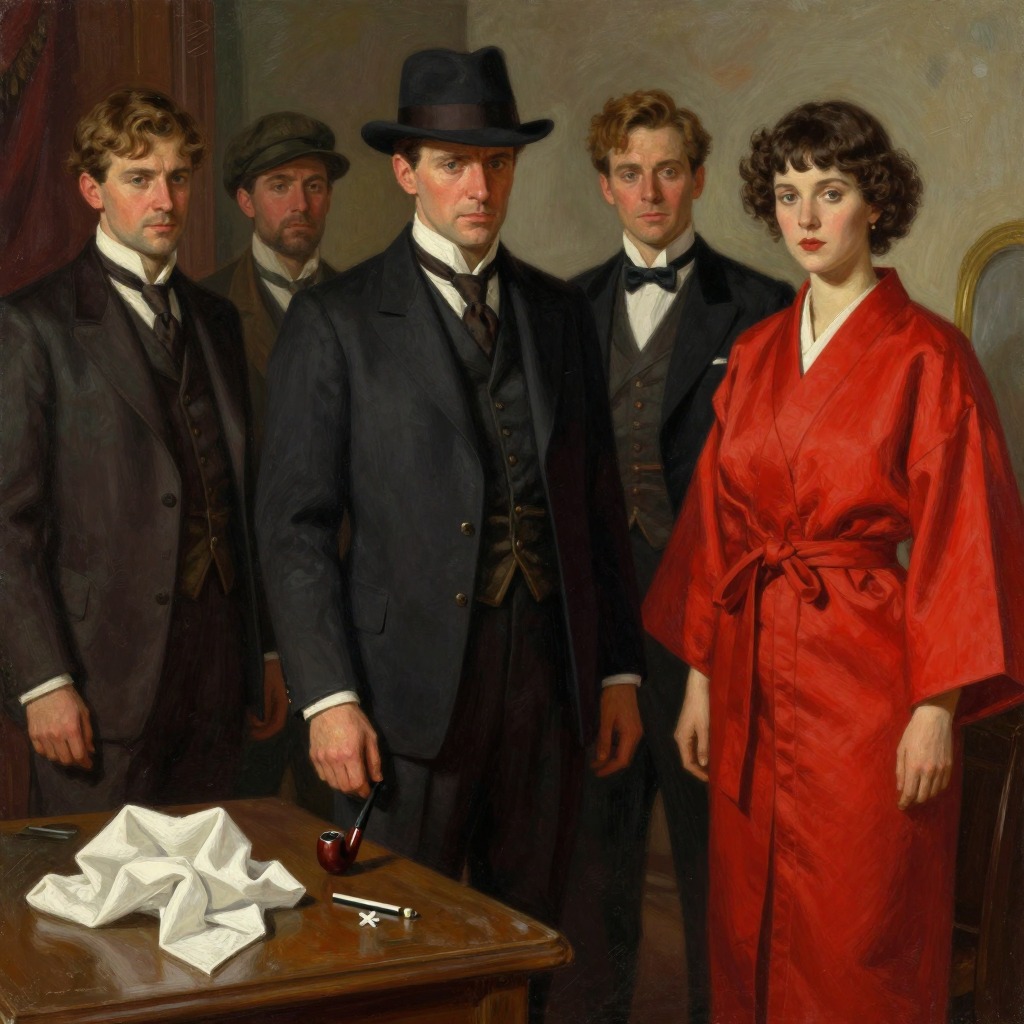
The Scarlet Kimono is first introduced into the narrative not as a physical object but as a fleeting, spectral presence. On the night of the murder, Poirot is awakened by a heavy thud against his door and, upon opening it, sees a woman wrapped in a scarlet kimono retreating from him down the corridor. This sighting is corroborated by the Wagon Lit conductor, Pierre Michel, who reports seeing a lady in a scarlet kimono with dragons on it going to the toilet at the far end of the coach. Later, Mary Debenham tells Poirot that she saw someone in a scarlet kimono some way down the corridor when she looked out early in the morning. Hector MacQueen also recalls a glimpse of a scarlet silk garment passing his compartment door. Colonel Arbuthnot, while not seeing the garment, remembers smelling a strong, fruity scent that he associates with a woman, further adding to the sensory impression of this mysterious figure. These multiple, consistent sightings create a powerful illusion of a real, independent person moving through the train, a phantom that the conspirators hoped would be the prime suspect.
Theatrical Planting and Discovery
The Scarlet Kimono is not merely a garment seen in passing; it is a prop in a carefully staged drama. The conspirators' plan was to create a false trail leading to a mysterious woman, and the kimono was the central piece of evidence for that trail. The most audacious act in this theatrical production occurs when Poirot, after interviewing all the passengers, returns to his own compartment to retrieve cigarettes. Opening his valise, he finds the scarlet silk kimono, neatly folded and embroidered with dragons, placed on top of his belongings. This is a direct challenge, a defiant act meant to further confuse the investigation and to implicate Poirot himself in the mystery. The kimono's placement in his luggage is a calculated move, designed to make him question his own perceptions and to add another layer of complexity to an already baffling case. The garment's origin is never explicitly confirmed, but Poirot suspects it belongs to Countess Andrenyi, whose luggage contains only a chiffon negligee, suggesting the kimono was borrowed for the performance.
Narrative Significance and Thematic Meaning
The Scarlet Kimono functions as a powerful symbol of the conspirators' collective effort and their theatrical approach to justice. It is a manufactured clue, a piece of stagecraft designed to create a diversion and protect the real perpetrators. The kimono's journey—from a fleeting vision in the corridor to a planted object in Poirot's suitcase—mirrors the entire investigation's trajectory, which is deliberately made to seem fantastically impossible. The garment represents the conspirators' control over the narrative, their ability to create and manipulate evidence to serve their purpose. In the end, the kimono is not a clue that leads to the truth but a testament to the elaborate, almost artistic, nature of the crime. It is a piece of the "perfect mosaic" that Poirot eventually sees, a mosaic where every detail, including the false ones, was carefully placed to create a single, unified, and deceptive picture. The kimono's ultimate significance lies not in who wore it, but in what its existence reveals: a meticulously planned conspiracy where even the false trails were part of the design.